Wednesday, 12 October 2011

Utopia and Dystopia

(Illustration for the 1516 first edition of Utopia)

Utopia

A Utopia to many is the idea of a perfect world. A good example of how people would see the perfect world is the garden of Eden, theres no illness, poverty or malice its the perfect place to live. Sir Thomas Moore from the 16th century created a fictional book called Utopia where the aim is for a perfect society on an island. Utopian ideas also translate into Religion. Heaven is classed as a Utopia, however with any Utopia there has to be an equal balance, the balance to heaven came with the banishment of Lucifer and the creation of hell.

 
Dystopia

A Dystopian world is an imperfect world, a place where everything is decaying and nothing works. Theres no justice system and anarchy reigns.  The perfect example of Dystopia is Hell, and the circles within it.

(The circles of hell created when Lucifer was cast from Heaven)

Wednesday, 5 October 2011

The Industrial Revolution


The Industrial Revolution bought a lot of life changing developments to Britain.


The development of Steam engines bought new ways of travel with:
  • Trains
  • Boats
This also led way to Smelting machinery for glass and sewing machines for large developments.


Along with the new modes of transport came more networks for travel with:
  • Canals for the new boats
  • Bridges for Trains
  • Transport Pathways
There were also changes to agricultural methods with:
  • Mining
  • Farming
Along with the revolution came the 'Birth of the Media' as along with all the new methods of transport we acquired the ability of mass distribution. This is when along with the Revolution we had one of the most infamous serial killers of all time, Jack The Ripper. With the new ability of distribution people all over the country knew of what was happening in London. It was no longer confined to where it was happening!

The Great Wave


The Great Wave print is one of the most iconic prints of all time. Created by Hokusai using woodblock print techniques between 1830 and 1833 during the edo period, it quickly became apparent some new techniques the western world could use for print techniques. Created using cherry wood after being engraved, the printer could run into thousands of copies before the woodblock became unusable. The print uses a limited palet to maximum effiency, drawing your eye straight in. This soon pathed the way to lithography using etched metal instead of wood for mas production in the western world.

The Mysterious Explorations of Jasper Morello


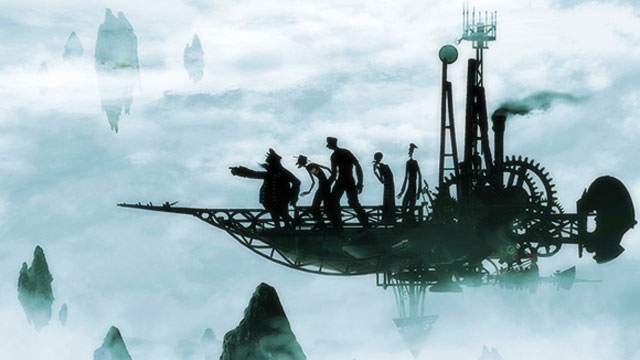
The Mysterious Explorations of Jasper Morello is a tale of an airship navigator during a futuristic Industrial Revolution era. The story follows Jasper after an accident in his past makes him believe he's not worthy of his naigational role. He's dragged back to his job after a plague hits the city he lives in and a scientist needs a new navigational pilot to find a new trade route in the skies. After being blown off course the crew find themselves on an uncharted island where Jasper proceeds to get attacked by a creature. The creature turns out to be the holder of the cure to the plague but taking the creature home also harbours terrible danger for the crew.

At first glance you'd say that this was one of Tim Burtons older short films, the stylization is akin to many of Burtons previous projects. The silhoutettes used throughout mask any proper features of the characters. The silhouettes are made up of random objects and animated in a stop motion style, this gives the characters jerky walking animations and movements but adds to the charm of the characters. The backgrounds are awash with sepia tones that gives the film the old feel with the contrasting 3-D visual software taking up the task of animating all the cogs and gearworks of the airships. The contrast between the jerky stop motion and the smooth as butter 3-D animation gives this short a charm not seen in an animation short for a long time.